
Salesforce CRM is the world’s leading customer relationship management platform in 2025, trusted by enterprises and growing businesses to power advanced sales automation and revenue operations.
Built for scalability and performance, Salesforce CRM combines artificial intelligence, cloud-based automation, and enterprise-grade customization, making it one of the best CRM software solutions available today.
Salesforce CRM has maintained its position as the #1 CRM software globally for more than a decade, serving over 150,000 businesses across industries. Its continued dominance in the customer relationship management software market is driven by its ability to support everything from basic lead management to complex, multi-layered enterprise sales processes. In 2025, Salesforce CRM remains the gold standard for organizations that view sales technology as a strategic growth driver.
Holding approximately 21.8% of the global CRM market share, Salesforce CRM outperforms its closest competitors combined. This leadership reflects the platform’s unmatched flexibility, deep automation capabilities, and extensive integration ecosystem. Businesses choose Salesforce CRM not only for its features but for its long-term reliability, security, and ability to evolve alongside changing market demands.
What makes Salesforce CRM especially attractive to modern businesses is its focus on intelligent sales automation. By integrating AI-driven insights, predictive analytics, and workflow automation, Salesforce CRM enables sales teams to focus on high-value activities while reducing manual effort and operational friction.
What Is Salesforce CRM?
Salesforce CRM is a cloud-based customer relationship management platform designed to centralize sales data, automate processes, and enhance customer engagement across the entire sales lifecycle. Built on the Salesforce Platform, it provides a unified environment where sales teams can manage leads, accounts, opportunities, and customer interactions with precision.
At its core, Salesforce CRM functions as a centralized sales hub that connects people, data, and processes. Sales professionals gain real-time visibility into customer activity, deal progress, and pipeline health, allowing for informed decision-making and accurate sales forecasting.
The platform’s cloud-based architecture ensures secure, anytime access to customer data, making Salesforce CRM ideal for distributed teams and remote sales operations. Its mobile CRM capabilities further extend productivity beyond the office, enabling real-time updates and engagement from anywhere.
Salesforce CRM also distinguishes itself through its massive ecosystem of integrations. Thousands of third-party applications connect seamlessly through the Salesforce AppExchange, allowing businesses to build a fully customized CRM environment tailored to their operational needs.
Key Features of Salesforce CRM
Sales Cloud and Opportunity Management
Salesforce CRM’s Sales Cloud provides advanced lead, contact, and opportunity management tools. Sales teams can guide prospects through customizable sales stages, ensuring consistent follow-ups and clear pipeline visibility.
Einstein AI and Predictive Analytics
Einstein AI is one of Salesforce CRM’s most powerful differentiators. It uses artificial intelligence to analyze customer data, predict deal outcomes, recommend next actions, and identify high-conversion opportunities, enabling data-driven sales strategies.
Contact and Account Management
Salesforce CRM delivers a 360-degree view of customers by consolidating communication history, engagement data, and transaction records. This comprehensive visibility supports personalized selling and long-term relationship building.
Sales Process Automation
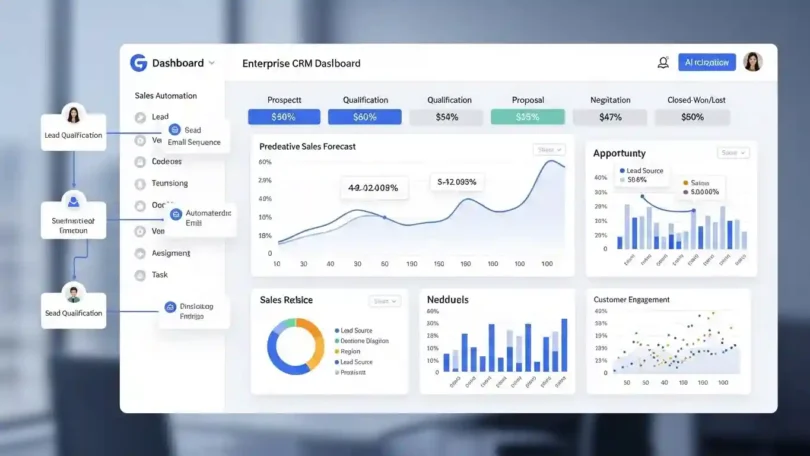
Workflow automation eliminates repetitive administrative tasks such as lead assignment, email follow-ups, record updates, and task creation. These sales automation tools improve efficiency and reduce the risk of missed opportunities.
Custom Dashboards and Reporting
Salesforce CRM offers highly customizable dashboards and reports that provide real-time insights into sales performance, pipeline metrics, and team productivity. Advanced analytics support strategic planning and revenue optimization.
Mobile CRM Capabilities
The Salesforce mobile app enables sales professionals to access customer data, update opportunities, and collaborate with teams in real time, ensuring uninterrupted productivity in field sales environments.
Use Cases of Salesforce CRM in Real Businesses
Large enterprises use Salesforce CRM to manage complex sales cycles involving multiple stakeholders, approval layers, and global operations. Integrations with ERP, marketing automation, and customer service platforms create seamless customer experiences across departments.
Small and mid-sized businesses adopt Salesforce CRM to build scalable sales infrastructures that grow with their operations. Typical use cases include lead capture, automated scoring, opportunity tracking, and performance reporting.
B2B service companies rely on Salesforce CRM to manage long-term client relationships, proposals, and project-based engagements. Its flexibility supports consulting firms, agencies, and professional services providers.
E-commerce businesses integrate Salesforce CRM to track customer behavior, personalize engagement, and improve customer lifetime value through unified sales and service data.
Pros and Cons of Salesforce CRM
Pros
Salesforce CRM offers unmatched customization, allowing businesses to tailor workflows, objects, and automation to exact requirements. Its integration ecosystem is one of the largest in the SaaS industry, supporting thousands of applications.
The platform’s scalability ensures it remains effective as organizations grow, while advanced AI and analytics provide insights that support long-term strategic decision-making.
Cons
Salesforce CRM’s complexity can be challenging for new users, often requiring training and onboarding investments. Pricing is higher than many competing CRM platforms, especially as advanced features and users are added.
Implementation can also be resource-intensive for organizations with complex requirements, sometimes necessitating professional consulting support.
Final Verdict: Is Salesforce CRM Worth It in 2025?
Salesforce CRM continues to set the benchmark for enterprise-grade customer relationship management in 2025. It is an ideal solution for organizations that require advanced automation, deep customization, and long-term scalability.
While smaller businesses with simple sales needs may find lighter CRM platforms more cost-effective, Salesforce CRM delivers exceptional value for companies that treat sales technology as a strategic investment.
Its continuous innovation in artificial intelligence, automation, and analytics ensures Salesforce CRM remains future-ready. For businesses seeking a powerful, flexible, and proven CRM platform, Salesforce CRM remains the most comprehensive solution available in today’s market.